
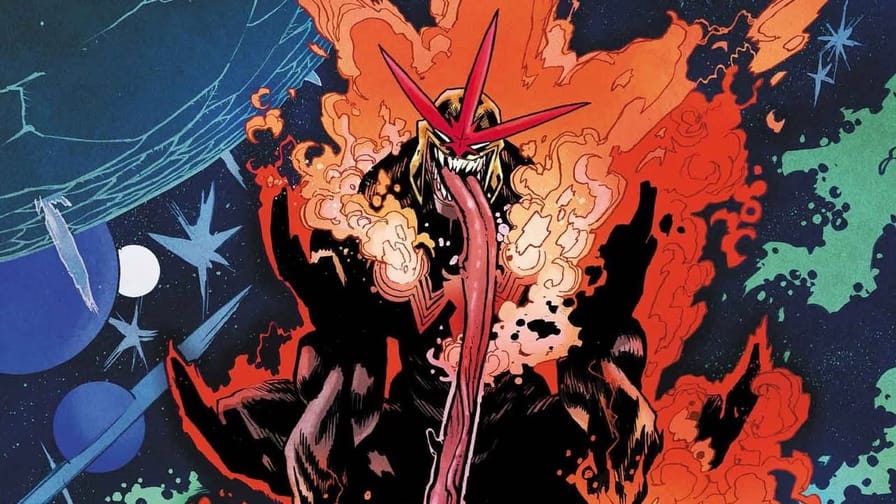
Hello and welcome back to Burning Questions, a weekly rundown of the topics burning up the Marvel Snap community. This week we got an OTA that included yet more nerfs to interaction, an icy reaction to the latest card release, and the conclusion of Grand Arena! Let's dive in!
1) Does the OTA represent the combo-fication of Snap?
This OTA has me worried and this line from the developer blog sums up my concerns:
“We still believe interaction is healthy, but don’t want the best decks in our game to be a stack of points generated through generic rate cards and the ability to shut down any strategy.”
They haven't demonstrated that they think interaction is healthy. If you think tech cards were too generally applicable and strong, we can agree on that. The death of Shang has been fine (not least because he was overrated and this finally got people to drop him), but I'm worried they're stripping all interaction from the game in favor of massive combos that go exponential. I've never felt like Shang's issue was strength, rather it was a lack of diversity and competition. Make players make meaningful decisions in deck-building as to which tech to pack.
As it stands, reaching for a 12-Card combo deck is often superior to playing any interaction. Give us interaction that is meaningful, but keep it complicated, harder to achieve, and less universal than old Shang. Part of the problem is they are now conditioning players to expect nerfs to any interaction that they lose to. Mercury plus Cannonball was a 7-Energy, 2-card combo that didn't always come together. Negasonic Teenage Warhead was a card that rewarded priority and sequencing. Game-winning turn 6 Interaction like those should be limited, but face up interaction like Mobius, Supergiant, Stardust, and Mercury has also been hit.
A lot of these cards have unfortunate collateral damage while hitting particular large combos, but I would argue a nerf to their big combo targets would have been appropriate alongside their nerfs. Meanwhile, they give us things like the Ghost rework and Super-Adaptoid that have minimal impact, even on the matchups they're meant to affect. Do they actually want us to interact or do they just want us to feel like we can interact? Hela, Torch/Living Tribunal, Mr. Negative, Bullseye, and x32 End-of-Turn triggers are all as frustrating to play against for some as tech cards that trip up your strategy are for others.
They call out “generic rate cards and the ability to shut down” opponents. Hey, don't threaten me with a good time, Second Dinner! Rate cards plus varied interaction pretty much sums up all of the metas I've most enjoyed in Snap's history. I want to be clear, I'm far less pro-tech than I am pro-rate cards. Combo-centric metas strip away two aspects of what makes Snap gameplay so great, card placement and decision making. Rate cards, good cards, mid-range, value, or whatever you want to call it being good has always meant more card diversity and, in particular, card package diversity, as it allows smaller packages of 2-3 cards to find homes.
In synergistic decks like Destroy and Discard there is an ideal 10-11 cards with maybe one or two slots of debate. Beyond that, players will just actively lower their win rate if they're missing one of the optimal cards or decide not to play it. These archetypes should always be good, but layering combo decks on top of synergy decks makes for a much more linear and repetitive experience. The combo-fication of Snap means less card diversity, accelerated power creep in order for new releases to keep up, less interaction, and a loss of much of what had always made Snap's gameplay among the best.
Please, Second Dinner, give us more meaningful ways to interact with our opponent, especially opponents that are building massive, exponential combos and ensure that decisions about card placement remain central to the game.
2) What's the point of Zombie Galacti?
I know I just spent multiple paragraphs railing on the combo-fication of Snap, but allow me to defend this recent, widely derided combo card release. Initial reactions to the card were near-universally negative:
DO NOT BUY THIS TRASH DO NOT BUY THIS TRASH DO NOT BUY THIS TRASH DO NOT BUY THIS TRASH DO NOT BUY THIS TRASH DO NOT BUY THIS TRASH DO NOT BUY THIS TRASH DO NOT BUY THIS TRASH DO NOT BUY THIS TRASH DO NOT BUY THIS TRASH DO NOT BUY THIS TRASH DO NOT BUY THIS TRASH DO NOT BUY THIS pic.twitter.com/T0zEsnQ2uK
— Bynx (@Bynx_Plays) October 28, 2025
MY THOUGHTS ON GALACTI.... pic.twitter.com/M3zdUnBZuC
— pawniepun (@pawniepun) October 29, 2025
So, what's the point of this card? Why release it? I actually think they should release a card exactly like this once per season! In some ways it's a near-perfect release! Surely, you think I'm insane, but let me explain. There are multiple incentives that can get people to buy a card and Second Dinner should appeal to each of them:
- Competitive players that want strong cards to win games (this is not the only incentive!)
- People who love the character and want to play with the card because of that
- Players who enjoy a deck-building puzzle
- Players who love to see a splashy effect go off in game
There are players for whom their favorite aspect of the game is to tinker and cook and fiddle with a new card in an attempt to make it work, and it's important to make content for those people as well. A type of card they should make an effort to release each season is a deck-building puzzle. To be successful, it needs to fit a few key criteria:
- Represent a new archetype. For a card to be appealing to tinkerers, it needs to be an exciting build-around with a worthwhile potential payoff.
- Have unique mechanics. As above, cards that are going to attract this type of player need to have interesting hooks to get people excited.
- Not immediately good. For people who love to cook with new cards, it would defeat the purpose if the card has an immediate, obvious home. These players are in it for the quest and that quest needs to be a journey with multiple steps or it wouldn't feel worth it to those players. Also, when a card fits the criteria for this type of release and it's very obviously powerful, you end up with a hard-to-interact-with combo card that isn't very fun to play against! So there is important pressure from two sides that mean a card like this can't release too powerful.
By those criteria, Second Dinner nailed the Galacti release. It's a tricky needle to thread, but they've done it here, as well as with Morgan Le Fay prior. The ideal state is a card that a bunch of people are building with initially, followed by a small core of players who keep it as a pet deck. They need to make a variety of different types of cards and “quirky, inconsistent, build-around” is absolutely one of them. If every card was powerful and easy to play upon release, the game would be much more hostile for free to play players, power creep would grow in an unmanageable way, and players would soon tire of the treadmill of constant over-powered new releases. I saw Dera playing this Galacti deck on stream to pretty solid results.
Dera's Galacti
Content creators are actually the perfect case for a card like this. They're incentivized to create novel decks, tend to have enough resources that they don't have to worry about every card they acquire having long-term value, and they can devote time to finding new ways to get a card to work. Dera spent multiple days and tried dozens of different builds and was eventually rewarded by finding a deck that is reasonably viable.
I suspect plenty of others are going to spend the next several days perfecting their Galacti lists and will be rewarded with solid, playable, B-tier decks that they can win with and feel an emotional attachment to (hello, Phoenix Force mains!). Not everyone is going to become a Phoenix Force main or a Morgan Le Fay fan, but these cards play a critical role in the content release schedule.
3) What did you play for Grand Arena?
As Grand Arena comes to a close, I want to review my thoughts on this mode. I felt like the mode was less compelling this time and most of the best strategies were pretty linear. It became clear right away that the Hulks and Mr. Fantastic champions were powerful, straightforward, and hard to interact with. By contrast, Magneto felt weak, slow, and was the only deck that started with two cards that were completely dead in the early game in its opening hand. So, naturally, I spent the vast majority of my time in Grand Arena playing Magneto decks! Here was my most successful build:
Scosco's Magneto
I think the way Grand Arena is structured makes it especially appealing to play something other than the statistical top decks and find underutilized strategies with the other champions. ZombiesGoNomNom posted this Mole Man deck that I was also able to have a lot of fun with and crush net deckers and pre-cons, just like I had with my Magneto deck.
Zombiesgonomnom Mole
What I've learned about LGTMs so far is they really reward going off the beaten path to find your own fun, far more than ladder does. This is partially because most LGTMs have much less diverse, but also less explored metagames than the main game, but also the lack of snapping and retreating makes experimentation feel more rewarding and growing-pain losses more palatable. You have until November 3rd to get the prizes you want out of the mode! Try something different in your last couple days!
Now, let's take a peek at the official Marvel Snap discord and grab a couple of questions from the ask-the-team channel.
4) Question:
For me, the only reason I play ladder is for the cardback. When I reach infinite, I always put that game mode down until season reset. It's a chore. It's a grind. Has the team discussed changing the awards around for ladder climb? Like putting the card back at 90 instead of gold?
I've seen multiple questions about issues the player base has and the common answer is "not on our current priority list". For those of us wondering, can you tell us what is actually on the priority list? LTGMs have been more fun than ever and the token shop changes are ...new. So I'm assuming that they were items on that priority list
Answer:
The purpose of the rewards is to add satisfying motivation to the achievement of the ladder climb—it sounds like that’s working perfectly for you. I don’t think it’s necessarily an improvement to change them so that you might set the game down faster—that’s kind of the opposite of the behavior we’d hope for, hence LTGMs.
As for our priorities, LTGMs are a big part of them. We’ve made 4 new ones this year with a 5th on the way, a 6th starting up, and some of the refreshes we have planned, such as adding characters to Grand Arena, are about as much work as a season used to be. Plus, with the success of the Event Pass, we’ve been examining how to integrate it with other modes.
Another major priority for us is improving the new user experience, which we’ve been working on for a couple months internally. Excited for some of those changes to roll out, and we have a good bit in motion there long-term too. We’ll be focusing further on character mastery as soon as that’s progressed.
Beyond that, we’ve got individuals working on tech debt and improved tooling for everything from localization to Snap Packs, as well as all the regular stuff we’re constantly working on in teams with each season. We are still a relatively small team, building the game and working on a few higher-scope features at a time accounts for a lot of resources.
Scosco's Note:
So, if they've made four new LGTMs with a fifth on the way that would be Sanctum Showdown (February), High Voltage: Overdrive (June), Grand Arena (July), Deadpool's Diner Reopening (September), with one more still to come by the end of the year. Team-ups in December, perhaps?
5) Question:
I have read almost every reply in the "Team Answers" and I know there have been so many complaints on matchmaking and bots. I do not want to add anymore to that discussion so let me ask another question... Does anyone on the team actually play the live client without any benefits or modifiers? I really think that either matchmaking is favoring opponents with tech cards that are perfect for your deck or bots have some form of advantage. I have played over 100 hours and have been testing over 40 decks and almost every time I change my synergy or win condition I go against decks that I didn't run into before those new options were added.
I know this is conspiratorial and has been a point of criticism in card games as a whole. But I have played over 1000 hours of this game and I do think something is not quite right. If everything is working as intended then I literally will not be playing on ladder after infinite or playing challenge outside rewards or testing and would rather face people in friendly battle with open deck lists.
Answer:
Everyone on the team plays live without benefits or modifiers, because they don’t exist and because playing the actual game is important to our work.
Honestly, the deck-based matchmaking conspiracy irks me because the premise is silly. We already have MMR “rigging” games for fairness based on players’ relative skill—that’s all matchmaking is. If we wanted the system to flip a “loser” switch (we don’t), it’d just pair you against way better players (it doesn’t). Very simple and no deck knowledge relevant.
But beyond deck-based matchmaking being a terrible method…why would we do it? The practice you’re imagining is so unfun it makes you want to play less, but we’re in the “play more” business.
Scosco's Note:
This answer is the best argument against deck-based matchmaking I've seen yet. It's arguing less that it's not a thing that would be worth doing and more that they already have a better way they could achieve this! They could use the already existing MMR system to give a person a match against a much higher MMR player if the goal was to get the player to lose or make their climb steeper. Deck-based matchmaking would be more complicated, difficult to achieve technically, and inferior to a system they already have access to, MMR matchmaking!
That's it for this week! Hit the comments and let me know what you've been cooking up with Galacti and in Grand Arena!